


Bacteria - rice

Contributers to this page: IRRI, Seed Health Unit, Los Banos, Philippines(Patria Gonzales, Evangeline Gonzales, Carlos Huelma, Myra Almodiel, Joel Dumlao).
|
Contents: |
Scientific names
Xanthomonas oryzae pv. oryzae (ex Ishiyama) Swings et al.
Syn. X. campestris pv. oryzae (Ishiyama) Dye
Significance
Yield losses (10-50%).
Symptoms
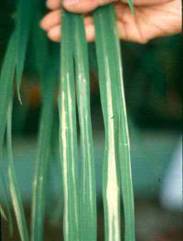
Blight (starts as water-soaked stripes a few centimeters below the leaf tip, or on the margin of the leaf blade; these stripes enlarge and turn yellow within a few days).
“Kresek” or wilting.
“Pale yellow leaf".
Host range
Leersia sayanuka Ohwi; L. oryzoides (L.) Sw., L. japonica, Zizania latifolia (Griesb.)Turcz. ex Stapf., Leptochloa chinensis (L.) Nees, L. panacea (Retz.) Ohwi, L. filiformis , Cyperus rotundus L. and C. difformis.
Geographic distribution
Asia, Australia, Africa, Latin America, the Carribean, and United States of America.
Biology and transmission
Survives primarily in rice stubbles and alternate weed hosts enters the host through stomata, wounds, and other injuries to leaves, hydathodes, cracks at the base of the leaf sheaths.
Irrigated and rainfed lowland ecosystems support the disease development.
Heavy rains with strong winds facilitate disease development by causing wounds in plants.
Dry weather helps bacterial exudates fall into irrigation water, spread the disease to neighboring fields.
Moderately high temperatures (25°C-30°C) increase the disease incidence.
|
|
Excessive use of nitrogen especially organic N as late topdressing, phosphate, and K deficiency, excess silicate and Mg predispose plant to infection.
Detection/indexing method in place at the CGIAR Center
- At IRRI – Seed Wash Assay Test (using semi selective medium).
-
Restriction Fragment Length Polymorphism (RFLP).
- Requires database to reference.
- Amplified Fragment Length Polymorphism (AFLP).
- Labor intensive and not efficient for diagnostics.
- Oligonucleotide arrays.
-
Macroarrays.
- Hybridize sample DNA to anchored pathogen.
- Specific oligos.
-
Antibody-based = Enzyme-Linked ImmunoSorbent Assay (ELISA).
- Requires increased processing time and expenses.
Treatment/control
- The disease can be effectively controlled with resistant cultivars.
- Cultural control includes avoiding excessive N fertilization, maintaining shallow water in nursery beds, providing good drainage during severe flooding, plowing under of rice sybbles and straw following harvest, and removing alternate hosts.
- Control of disease with copper compounds, antibiotics, and other chemicals has not proven effective.
Procedure followed at the centers in case of positive test
- Seeds found to be positive with the organism are deleted from shipments for export.
- Bacterial testing is not conducted on incoming rice seeds but shall be planted in post entry plant quarantine area only. Plants are closely monitored during its active growth. Plants showing disease symptoms are immediately destroyed and disposed according to the recommendation of the Philippine Plant Quarantine Service.
References and further reading
Ou SH. 1985. Rice Diseases 2nd ed. The Commonwealth Mycological Institute. UK
Mew TW, Misra JK. 1994. A Manual of Rice Seed Health Testing. IRRI.
Webster RK, Gunnel PS, editors. 1992. Compendium of Rice Diseases. The American Phytopathological Society. USA
Scientific names
Xanthomonas oryzae pv. oryzicola (Fang et al) Swings et al.
syn. X. campestris pv. oryzicola (Fang et al) Dye; X. translucens f.sp. oryzicola
Significance
Yield losses estimated at 1-17% depending on cultivar and climatic condition.
Symptoms
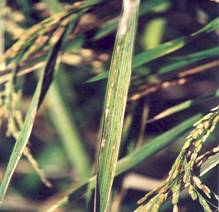
Translucent interveinal streaks (variable length on the leaf); old lesions become light brown.
Yellowish droplet of bacterial ooze on lesions under humid conditions; ooze look like beads under dry conditions.
Host range
All wild species of the genus Oryza can be infected and may serve as reservoirs of inoculum.
Geographic distribution
Widely distributed in Tropical Asia and in West Africa.
Biology and transmission
The bacterium survives largely on infected seed and straw; may also be able to survive in irrigation water.
The bacterium enters the host through stomates or wounds and multiplies in parechymatous tissue.
Bacterial exudates from leaf lesions are disseminated primarily by splashing and windblown rain, also by leaf contact and irrigation water.
Disease develops in both lowland and upland ecosystems.
Disease development is favored by rain, high humidity (more that 80%) and high temperature (more that 30°C).
Infected seeds and contaminated water can introduce the disease to new areas.
Detection/indexing method in place at the CGIAR Center
|
- At IRRI – Seed Wash Assay Test (using semi selective medium).
-
Restriction Fragment Length Polymorphism (RFLP).
- Requires database to reference.
-
Amplified Fragment Length Polymorphism (AFLP).
- Labor intensive and not efficient for diagnostics.
- Oligonucleotide arrays.
-
Macroarrays.
- Hybridize sample DNA to anchored pathogen.
- Specific oligos.
-
Antibody-based = Enzyme-Linked ImmunoSorbent Assay (ELISA).
- Requires increased processing time and expenses.
Treatment/control
- The disease can be effectively controlled with resistant cultivars and the use of treated seeds.
Procedure followed at the centers in case of positive test
- Seeds found to be positive with the organism are deleted from shipments for export.
- Bacterial testing is not conducted on incoming rice seeds but shall be planted in post entry plant quarantine area only. Plants are closely monitored during its active growth. Plants showing disease symptoms are immediately destroyed and disposed according to the recommendation of the Philippine Plant Quarantine Service.
References and further reading
Ou SH. 1985. Rice Diseases 2nd ed. The Commonwealth Mycological Institute. UK
Mew TW, Misra JK. 1994. A Manual of Rice Seed Health Testing. IRRI.
Webster RK, Gunnel PS, editors. 1992. Compendium of Rice Diseases. The American Phytopathological Society. USA
Comments
- No comments found
Leave your comments
Post comment as a guest