


Viruses - potato

Contributors to this section: CIP, Lima, Peru (Carols Chuquillanqui, Segundo Fuentes, Ivan Manrique, Giovanna Muller, Willmer Pérez, Reinhard Simon, David Tay, Liliam Gutarra); CIP, Nairobi, Kenya (Ian Barker); FERA, UK (Derek Tomlinson, Julian Smith, David Galsworthy, James Woodhall).
Scientific name
Potato Yellow Vein Virus (PYVV)
Significance
EPPO A1 quarantine organism.
Symptoms
Foliage: Symptoms of primary infection appear 10 to 15 days after infection as a bright yellowing of small (tertiary) leaf veins. Sometimes, only a few yellow spots developed. As the plants grew, secondary veins become affected. Later, leaf laminae may also become yellow. The main (primary) veins are rarely affected and remained green until plants died (Wale, 2008; Salazar, 1998).
Secondary infections: Symptom development in secondarily infected plants begins in the same way as in primarily infected plants. Some plants derived from tubers of infected plants are asymptomatic and the progeny of these individuals may develop both symptomatic and asymptomatic plants (Wale, 2008; Salazar, 1998).
Tubers: Reduction in number and size however can be identical to produced from healthy plants.
Hosts
Solanum tuberosum (potato)
The primary natural host of PYVV is potato. The known experimental host range of PYVV only includes Lycopersicon esculentum cv. Rutgers and the weed species Tagetes sp., Catharanthus roseus, Polygonum nepalense and Polygonum sp. (Salazar, 1998).
Geographic distribution
Europe, South America
Biology and transmission
PYVV is transmitted by the whitefly Trialeurodes vaporariorum (Vega, 1970; Tamayo and Navarro, 1984). Moreover, PYVV is perpetuated in potato tuber seed and can be transmitted by graft-inoculation, but not mechanically or by contact (Salazar, 1998). The virus is also transmitted through infected potato tubers. The virus can also infect and survive in weeds that play an important role in virus spread and establishment.
Detection/indexing method in place at CIP
- At CIP, the virus is detected by PCR and NASH.
Treatment/control
- In seed certification schemes, no virus infections must be tolerated during the growing season. Stocks of in vitro cultures used for propagation should be from pathogen-free plants and maintained under conditions designed to prevent infection and contamination.
Procedure followed at CIP in case of positive test
- In CIP if pathogen is detected the imported germplasm must be cleaned by thermotherapy.
References of protocols at EPPO, NAPPO or other similar organization
EPPO/OEPP. 2006. Phytosanitary procedures. Post-entry quarantine for potato. PM3/21(2)
OEPP/EPPO. 2008. EPPO Standards PM 1/ 2 (17). EPPO A1 and A2 lists of pests recommended for regulation as quarantine pests.
References and further reading
CABI. 2007. Crop Protection Compendium [online] Available from URL: www.cabi.org/compendia/cpc/ Commonwealth Agricultural Bureau International (CABI), Wallingford, UK. Date accessed 07 May 2010
Hooker WJ (ed.). 1981. Compendium of potato diseases. American Phytopathological Society. St. Paul, Minnesota, USA. 125 pp.
Jeffries C. 1998. FAO/IPGRI Technical guidelines for the safe movement of Germplasm. No. 19. Potato. Food and Agriculture Organization of the United Nations, Rome/International Plant Genetic Resources Institute, Rome.
Salazar LF, Müller G, Owens RA, Querci M, Zapata JL. 1998. Identification of potato yellow vein virus (PYVV). In: Proceedings of the 14th Triennial Conference of the European Association for Potato Research, 63-64 (Abstract).
Tamayo PJ, Navarro R. 1984. Aumenta la incidencia del virus del amarillamiento de venas de la papa en Antioquia. ASCOLFI Informa (Bogotá), 10(5):40–42.
Vega JG, 1970. Transmisión, purificación y caracterización del agente causal del "amarillamiento de venas" en papa. M. Sc. Thesis. Universidad Nacional e Instituto Colombiano Agropecuario (ICA), Bogotá, Colombia, 47 pp.
Wale S, Platt HW (Bud), Cattlin N. 2008. Diseases, pests and disorders of Potatoes. A color Handbook. Manson Publishing, London, UK.176 pp.
Seed Health General Publication Published by the Center or CGIAR
Jeffries C. 1998. FAO/IPGRI Technical guidelines for the safe movement of Germplasm. No. 19. Potato. Food and Agriculture Organization of the United Nations, Rome/International Plant Genetic Resources Institute, Rome.
Scientific name
Andean Potato Mottle Virus (APMoV)
Significance
EPPO A1 quarantine organism.
Symptoms
Foliage: Yellow local lesions or blotches, mild or severe mottle some leaf malformation. Dwarfing of plants. Secondary symptoms are more severe, leaf malformation and stunting (Jeffries, 1998, EPPO, 2007). Symptoms vary widely with potato cultivar (Fribourg, 2007 )
Tubers: No tuber symptoms have been reported, but the virus may induce delayed emergence of sprouts (Fribourg, 2007).
Hosts
APMoV is found naturally in Solanum tuberosum (potato) but can infects Capsicum annuum (bell pepper), Capsicum chinense (habanero pepper), Capsicum frutescens (chilli), Solanum melongena (aubergine or eggplant), Datura stramonium (jimsonweed), Nicandra physalodes (apple of Peru) and Nicotiana rustica (wild tobacco) (CABI, 2007).
Geographic distribution
Asia, Central America, South America
Biology and transmission
APMoV is transmitted by Diabrotica spp. (Fribourg et al., 1977). An isolate from Capsicum was transmitted by Diabrotica balteata (Valverde et al., 1995). Several wild potato species are susceptible to the virus and may be important as natural reservoirs from which the vectors could carry the virus to potato fields (Fribourg et al., 1977). The virus can be transmitted by contact between plants and is not transmitted by true seed, but is carried by potato tubers (Fribourg et al., 1977, Jeffries, 1998). Vegetative parts including seedlings and micropropagated plants are liable to carry the virus in trade. Growing medium accompanying plants doesn’t carry virus propagules (CABI, 2007).
Detection/indexing method in place at CIP
- At CIP, the virus is detected by DAS-ELISA and host range.
Treatment/control
- In seed certification schemes, no virus infections must be tolerated during the growing season. Stocks of in vitro cultures used for propagation should be from pathogen-free plants and maintained under conditions designed to prevent infection and contamination.
Procedure followed at the center in case of positive test
- In CIP if pathogen is detected the imported germplasm must be cleaned by thermotherapy.
References of protocols at EPPO, NAPPO or other similar organization
CABI/EPPO. Data sheets on Quarantine pest: potato Andean mottle commovirus. Prepared by CABI and EPPO for the European Communities. 4 p.
NAPPO. 2007. NAPPO Regional Standard for Phytosanitary Measures (RSPM). RSPM No. 3. Requirements for importation of potatoes into a NAPPO Member Country. Ottawa, Ontario, Canada. 53 pp.
OEPP/EPPO. 2008. EPPO Standards PM 1/ 2 (17). EPPO A1 and A2 lists of pests recommended for regulation as quarantine pests.
References and further reading
CABI. 2007. Crop Protection Compendium [online] Available from URL: www.cabi.org/compendia/cpc/ Commonwealth Agricultural Bureau International (CABI), Wallingford, UK. Date accessed 07 May 2010
Fribourg C. 2007. Virus, viroides y mollicutes de las plantas cultivadas en el Perú. Universidad Nacional Agraria La Molina. Lima, Perú. 219 p.
Fribourg CE, Jones RAC, Koenig R. 1977. Andean potato mottle, a new member of the cowpea mosaic virus group. Phytopathology 67(8):969–974
OEPP/EPPO. 1984. Data sheets on quarantine organisms No. 128. Potato viruses (non-European). Bulletin OEPP/EPPO Bulletin 14, 11–22.
Valverde RA, Black LL, Dufresne DJ. 1995. A comovirus affecting tabasco pepper in central America. Plant Disease, 79(4):421–423
Seed Health General Publication Published by the Center or CGIAR
Jeffries C. 1998. FAO/IPGRI Technical guidelines for the safe movement of Germplasm. No. 19. Potato. Food and Agriculture Organization of the United Nations, Rome/International Plant Genetic Resources Institute, Rome.
Scientific name
Andean Potato Latent Virus (APLV)
Significance
EPPO A1 quarantine organism.
Symptoms
Foliage: Primary infections are latent or induce mild chlorotic netting of minor veins. Secondary symptoms range from mild to severe mosaic with necrotic flecking, curling and leaf-tip necrosis. The symptoms vary depending on virus strain, potato cultivar and environmental conditions (Jones and Fribourg, 1978). Symptoms were not observed in Ulluco (Lizárraga et al., 1996)
Hosts
In natural conditions APLV infects potato (Solanum tuberosum) and Ulluco (Ullucus tuberosus). The host range includes Solanaceae, Chenopodiaceae and Amaranthaceae (CABI, 2007; Jeffries, 1998).
Geographic distribution
Asia, South America
Biology and transmission
The virus is readily transmitted within the field by contact but is transmitted with low efficiency by the potato flee beetle (Epitrix sp.) and also by true potato seed (Jones and Fribourg, 1977). Transmission of APLV from an infected plant to its tubers was erratic (Jones and Fribourg, 1978). Vegetative parts including seedlings and micropropagated plants are liable to carry the virus in trade (CABI, 2007).
Detection/indexing method in place at CIP
- At CIP, the virus is detected by DAS-ELISA and host range.
Treatment/control
- In seed certification schemes, no virus infections must be tolerated during the growing season. Stocks of in vitro cultures used for propagation should be from pathogen-free plants and maintained under conditions designed to prevent infection and contamination.
Procedure followed at the center in case of positive test
- In CIP if pathogen is detected the imported germplasm must be cleaned by thermotherapy.
References of protocols at EPPO, NAPPO or other similar organization
CABI/EPPO. Data sheets on Quarantine pest: potato Andean latent tymovirus. Prepared by CABI and EPPO for the European Communities. 4 p.
NAPPO. 2007. NAPPO Regional Standard for Phytosanitary Measures (RSPM). RSPM No. 3. Requirements for importation of potatoes into a NAPPO Member Country. Ottawa, Ontario, Canada. 53 pp.
OEPP/EPPO. 1984. Data sheets on quarantine organisms No. 128. Potato viruses (non-European). Bulletin OEPP/EPPO Bulletin 14, 11–22.
OEPP/EPPO. 2008. EPPO Standards PM 1/ 2 (17). EPPO A1 and A2 lists of pests recommended for regulation as quarantine pests.
References and further reading
CABI. 2007. Crop Protection Compendium [online] Available from URL: www.cabi.org/compendia/cpc/ Commonwealth Agricultural Bureau International (CABI), Wallingford, UK. Date accessed 07 May 2010
Jones RAC, Fribourg CE. 1978. Symptoms induced by Andean potato latent virus in wild and cultivated potatoes. Potato Research, 21(2):121–127
Jones RAC, Fribourg CE. 1977. Beetle, contact and potato true seed transmission of Andean potato latent virus. Annals of Applied Biology, 86(1):123–128.
Lizárraga C, Santa Cruz M, Jayasinghe U.1996. Detection of an isolate of Andean potato latent tymovirus in ulluco (Ullucus tuberosus Caldas). Plant Disease, 80(3):344.
Lizárraga C, Santa Cruz M, Marca JL, Salazar LF.1999. The importance of the viruses infecting Ullucus tuberosus Caldas in Peru. Fitopatología 34(1):22–28.
Seed Health General Publication Published by the Center or CGIAR
Jeffries C. 1998. FAO/IPGRI Technical guidelines for the safe movement of Germplasm. No. 19. Potato. Food and Agriculture Organization of the United Nations, Rome/International Plant Genetic Resources Institute, Rome.
Scientific name
Potato Yellowing Virus (PYV)
Other scientific names
Potato yellowing alfamovirus
Andean potato yellowing virus
Virus SB-22
Significance
EPPO A1 quarantine organism.
Symptoms
Foliage: Main symptoms include yellowing and premature senescence. The symptoms vary depending on potato cultivar (Jeffries, 1998, Fuentes y Jayasinghe, 1993)
Tuber: Effect on yield is unknown. (Fribourg, 2007; Valkonen et al., 1992)
Geographic distribution
South America
Biology and transmission
PYV is transmitted semi-persistently by Myzus persicae, and through true seed of Physalis floridana, Solanum tuberosum and Capsicum annuum (Fuentes, 1992; Valkonen et al., 1992). Vegetative parts including seedlings and micropropagated plants are liable to carry the virus in trade (CABI, 2007).
Detection/indexing method in place at CIP
- At CIP, the virus is detected by DAS-ELISA and host range.
Treatment/control
- In seed certification schemes, no virus infections must be tolerated during the growing season. Stocks of in vitro cultures used for propagation should be from pathogen-free plants and maintained under conditions designed to prevent infection and contamination.
Procedure followed at the center in case of positive test
- In CIP if pathogen is detected the imported germplasm must be cleaned by thermotherapy.
References of protocols at EPPO, NAPPO or other similar organization
CABI/EPPO. Data sheets on Quarantine pest: potato yellowing alfamovirus. Prepared by CABI and EPPO for the European Communities. 3 p.
NAPPO. 2007. NAPPO Regional Standard for Phytosanitary Measures (RSPM). RSPM No. 3. Requirements for importation of potatoes into a NAPPO Member Country. Ottawa, Ontario, Canada. 53 pp.
OEPP/EPPO. 2008. EPPO Standards PM 1/ 2 (17). EPPO A1 and A2 lists of pests recommended for regulation as quarantine pests.
References and further reading
CABI. 2007. Crop Protection Compendium [online] Available from URL: www.cabi.org/compendia/cpc/ Commonwealth Agricultural Bureau International (CABI), Wallingford, UK. Date accessed 07 May 2010
Fribourg C. 2007. Virus, viroides y mollicutes de las plantas cultivadas en el Perú. Universidad Nacional Agraria La Molina. Lima, Perú. 219 p.
Fuentes S. Jayasinghe YU.1993. Amarillamiento de la papa, causado por un nuevo virus baciliforme. Fitopatologia 28(1):22–37
Fuentes S. 1992. Identificación, características y distribución de un virus baciliforme aislado de papa (Solanum tuberosum L.). Tesis M. Sc. Universidad Nacional Agraria La Molina, Lima, Perú 184 p.
OEPP/EPPO. 1984. Data sheets on quarantine organisms No. 128. Potato viruses (non-European). Bulletin OEPP/EPPO Bulletin 14, 11–22.
Valkonen, J.P.T.; Pehu, E. and K. Watanabe. 1992. Symptom expression and seed transmission of alfalfa mosaic virus and potato yellowing virus (SB-22) in Solanum brevidens and S. etuberosum. Potato Research 35(4):403-410.
Seed Health General Publication Published by the Center or CGIAR
Jeffries C. 1998. FAO/IPGRI Technical guidelines for the safe movement of Germplasm. No. 19. Potato. Food and Agriculture Organization of the United Nations, Rome/International Plant Genetic Resources Institute, Rome.
Potato yellow dwarf nucleorhabdovirus
Scientific name
Potato Yellow Dwarf Virus (PYDV)
Significance
EPPO A1 quarantine organism.
Symptoms
Foliage: PYDV causes stunted growth, dwarfing, apical yellowing and necrosis. Death of the apex occurs and is followed by necrosis of the upper axillary buds. Leaflet margins roll upward while the longitudinal axis curves downward. Pith necrosis of stems is common (Jeffries, 1998, CABI, 2007).
Tubers: Reduced in size, deformed with surface cracking and internal spots. Cracked tissues are covered with a corky layer (CABI, 2007).
Hosts
PYDV infects naturally wild Solanaceae and Chrysanthemum leucathemum var. pinnatifidum (ox-eye daisy). Artificially PYDV has been transmitted to species in the families Apocynaceae, Fabaceae, Lamiaceae, Polygonaceae and Scrophulariaceae (OEPP/EPPO, 1980; CABI, 2007). PYDV has been reported on ornamental herbaceous plants Mirabilis jalapa, Nicoitiana alata, Tagetes erecta and Zimmia elegans (Lockhart,1989).
Geographic distribution
North America
Biology and transmission
PYDV is transmitted in a persistent manner. One strain has been reported by its transmission by Aceratogallia sanguinolenta and second strain by Agallia constricta. Both strains can be transmitted by Agallia quadripunctata (Jeffries, 1998). PYDV is carried by potato tubers, but not by true seed. In principle, PYDV could be carried by potato tubers in international trade but micropropagated plants are not liable to carry the virus (CABI, 2007).
Detection/indexing method in place at CIP
- At CIP, virus is detected DAS-ELISA
Treatment/control
- In seed certification schemes, no virus infections must be tolerated during the growing season. Stocks of in vitro cultures used for propagation should be from pathogen-free plants and maintained under conditions designed to prevent infection and contamination.
Procedure followed at the center in case of positive test
- In CIP if pathogen is detected the imported germplasm must be cleaned by thermotherapy.
References of protocols at EPPO, NAPPO or other similar organization
NAPPO. 2007. NAPPO Regional Standard for Phytosanitary Measures (RSPM). RSPM No. 3. Requirements for importation of potatoes into a NAPPO Member Country. Ottawa, Ontario, Canada. 53 pp.
OEPP/EPPO. 1980. Data sheets on quarantine organisms No. 30. Potato Yellow Dwarf Virus. Bulletin OEPP/EPPO Bulletin 10(1):41–46.
OEPP/EPPO. 2008. EPPO Standards PM 1/ 2 (17). EPPO A1 and A2 lists of pests recommended for regulation as quarantine pests.
References and further reading
CABI. 2007. Crop Protection Compendium [online] Available from URL: www.cabi.org/compendia/cpc/ Commonwealth Agricultural Bureau International (CABI), Wallingford, UK. Date accessed 07 May 2010
Lockhar BEL.1989. Recurrence of natively occurring potato yellow dwarf virus in Minnesota. Plant Disease, 73(4):321–323.
Seed Health General Publication Published by the Center or CGIAR
Jeffries C. 1998. FAO/IPGRI Technical guidelines for the safe movement of Germplasm. No. 19. Potato. Food and Agriculture Organization of the United Nations, Rome/International Plant Genetic Resources Institute, Rome.
Scientific name
Potato Black Ringspot Virus (PBRSV)
Other scientific names
Calico disease of potato
Tobacco ringspot virus (Andean potato calico strain) (Fribourg, 1977)
Significance
EPPO A1 quarantine organism.
Symptoms
Foliage: The symptoms vary depending on potato cultivar and virus strain. Systematically PBRSV cause necrotic spots and ringspots (Jeffries, 1998) and sometimes systemic necrosis (Fribourg, 1983). Calico-like symptoms (bright yellow areas on the margins of middle and upper leaves) are caused in some potato cultivars. Most of the plant foliage may eventually turn yellow without stunting or leaf deformations (Fribourg, 1983).
Hosts
PBRSV infects naturally potatoes (Solanum tuberosum), Arracacia xanthorrhiza (arracacha) and Oxalis tuberosa (oca) (Salazar and Harrison, 1978; Lizarraga et al., 1994; Jeffries, 1998).
Geographic distribution
South America
Biology and transmission
Local spread is by contact between plants and possibly nematode vectors but none has been identified. PBRSV is readily transmitted through tubers (Salazar and Harrison, 1978) and through true seed (Jones, 1982). PBRSV could be also carried by tubers of oca or arracacha (CABI, 2007). Micropropagated plants are liable to carry the virus (CABI, 2007). PBRSV is serologically distantly related to Tobacco ringspot and Eucharis mottle viruses.
Detection / indexing method in place at CIP
- At CIP, virus detected by DAS-ELISA
Treatment/control
- In seed certification schemes, no virus infections must be tolerated during the growing season. Stocks of in vitro cultures used for propagation should be from pathogen-free plants and maintained under conditions designed to prevent infection and contamination.
Procedure followed at the center in case of positive test
- In CIP if pathogen is detected the imported germplasm must be cleaned by thermotherapy.
References of protocols at EPPO, NAPPO or other similar organization
CABI/EPPO. Data sheets on Quarantine pest: Potato black ringspot nepovirus. Prepared by CABI and EPPO for the European Communities. 3 p.
NAPPO, 2007. NAPPO Regional Standard for Phytosanitary Measures (RSPM). RSPM No. 3. Requirements for importation of potatoes into a NAPPO Member Country. Ottawa, Ontario, Canada. 53 pp.
OEPP/EPPO. 2008. EPPO Standards PM 1/ 2 (17). EPPO A1 and A2 lists of pests recommended for regulation as quarantine pests.
References and further reading
CABI. 2007. Crop Protection Compendium [online] Available from URL: www.cabi.org/compendia/cpc/ Commonwealth Agricultural Bureau International (CABI), Wallingford, UK. Date accessed 07 May 2010
Fribourg CE. 1977. Andean potato calico strain of tobacco ringspot virus. Phytopathology 67(2):174–178
Fribourg CE. 1983. Tobacco ringspot virus. In: Compendium of Potato Diseases (ed. By Hooker, W.J.), pp.84-85. American Phytopathological Society, St. Paul, Minnesota, USA
Jones RAC.1982. Tests for transmission of four potato viruses through potato true seed. Annals of Applied Biology 100(2):315–320
Lizarraga C, Chuquillanqui C, Jayasinghe U. 1994. A strain of PBRV (potato black rinspot virus) isolated from Arracacha (Arracacia xanthorhiza). Fitopatología 29:144–149.
Salazar LF, Harrison BD. 1978. Host range and properties of potato black ringspot virus. Annals of Applied Biology 90 (3): 375–386.
Seed Health General Publication Published by the Center or CGIAR
Jeffries C. 1998. FAO/IPGRI Technical guidelines for the safe movement of Germplasm. No. 19. Potato. Food and Agriculture Organization of the United Nations, Rome/International Plant Genetic Resources Institute, Rome.
Scientific name
Potato Virus T (PVT)
Significance
EPPO A1 quarantine organism.
Symptoms
Symptomless in potato, occasionally causes necrosis or chlorotic symptoms in some potato cultivars (CABI, 2007, Jeffries, 1998). Experimentally potato clone CPC 2783 and cultivars King Edward and Cara show vein necrosis or systemic top necrosis (Fribourg, 2007)
Hosts
PVT infects naturally potatoes (Solanum tuberosum), Oca (Oxalis tuberosa), Ulluco (Ullucus tuberosus) and Mashua (Tropaeolum tuberosum) (Lizarraga et al., 2000, Jeffries, 1998). Some wild potatoes are infected experimentally but could be natural reservoirs (Fribourg, 2007).
Geographic distribution
South America
Biology and transmission
PVT is transmitted by potato tubers, true potato seed and pollen (Fribourg, 2007; CABI, 2007). Mechanical transmission (e.g., by machinery) included plant-to-plant is reported by Jones (1982). PVT could be also carried by tubers of oca, mashua or ulluco (CABI, 2007). Micropropagated plants are liable to carry the virus (CABI, 2007).
Detection/indexing method in place at CIP
- At CIP, the virus is detected by host range and NASH.
Treatment/control
- In seed certification schemes, no virus infections must be tolerated during the growing season. Stocks of in vitro cultures used for propagation should be from pathogen-free plants and maintained under conditions designed to prevent infection and contamination.
Procedure followed at the center in case of positive test
- In CIP if pathogen is detected the imported germplasm must be cleaned by thermotherapy.
References of protocols at EPPO, NAPPO or other similar organization
CABI/EPPO. Data sheets on Quarantine pest: Potato T Trichovirus. Prepared by CABI and EPPO for the European Communities. 3 p.
NAPPO, 2007. NAPPO Regional Standard for Phytosanitary Measures (RSPM). RSPM No. 3. Requirements for importation of potatoes into a NAPPO Member Country. Ottawa, Ontario, Canada. 53 pp.
References and further reading
CABI. 2007. Crop Protection Compendium [online] Available from URL: www.cabi.org/compendia/cpc/ Commonwealth Agricultural Bureau International (CABI), Wallingford, UK. Date accessed 07 May 2010
Fribourg C. 2007. Virus, viroides y mollicutes de las plantas cultivadas en el Perú. Universidad Nacional Agraria La Molina. Lima, Perú. 219 p.
Jones RAC. 1982. Tests for transmission of four potato viruses through potato true seed. Annals of Applied Biology 100(2):315–320
Lizarraga C, Querci M, Santa Cruz MS, Bartolini I, Salazar LF. 2000. Other natural hosts of Potato virus T. Plant disease 84 (7): 736–738
Seed Health General Publication Published by the Center or CGIAR
Jeffries C. 1998. FAO/IPGRI Technical guidelines for the safe movement of Germplasm. No. 19. Potato. Food and Agriculture Organization of the United Nations, Rome/International Plant Genetic Resources Institute, Rome.
Scientific name
Potato Virus Y (PVY)
Strains on potato:
PVYc = stipple streak strain
PVYo =common strain
PVYN = tobacco veinal necrosis strain (including PVY NTN, the so-called tuber necrotic strain of N).
PVYZ = strain group
Significance
High importance. Yield losses reach 10-80%.
Symptoms
Foliage: Symptoms include mild and severe mosaic, rugosity; crinkling, dropping of leaves (leaf drop streak), severe systemic necrosis and dwarfing. Symptoms vary widely with virus strain and potato cultivar (Jeffries, 1998).
PVYN isolates usually cause only slight leaf symptoms in comparison to PVYo and PVYC, which cause much more severe symptoms (Jeffries, 1998).
Primary symptoms of PVYo and PVYC are necrosis, mottling, yellowing of leaflets, leaf drops and premature death of plants (Wale et al., 2008).
Plants with secondary PVYo infection are dwarfed and leaves are mottled and crinkled (Hooker, 1981).
Tubers: PVYNTN isolates cause severe superficial tuber necrosis (potato tuber necrotic ringspot disease) and may also cause necrotic foliar symptoms. Some PVYN isolates may also cause tuber necrosis (Jeffries, 1998).
Hosts
Peppers (Capsicum), bell pepper (Capsicum annuum), tomato (Lycopersicon esculentum), tobacco (Nicotiana tabacum), potato (Solanum tuberosum), nightshade (Solanum sp.), black nightshade (Solanum nigrum), tree tomato (Cyphomandra betacea), Dahlia and Petunia spp., Physalis spp.and Solanum dulcamara.
Geographic distribution
Asia, Europe, Africa, North America, Central America, South America, Oceania
Biology and transmission
PVY is transmitted in a non-persistent manner by more than 50 aphid species (Kennedy et al., 1962; Sigvald, 1984; Salazar, 1996; Ragsdale et al., 2001; Robert and Bourdin, 2001). Virus spread takes place mainly by winged aphids (Wale, 2008). PVY has not been reported in true seed but transmission can occur readily in potato tubers and other vegetative parts including seedlings and micropropagated plants. Growing medium accompanying plants doesn’t carry virus propagules (CABI, 2007). Incidence in seed potato tubers can be very high in the absence of certification schemes or with tolerant cultivars. Many plant species, mostly in the Solanaceae, but also in the Chenopodiaceae and Leguminosae are hosts to PVY. Potato volunteer plants are virus reservoir hosts (Hooker, 1981).
Detection/indexing method in place at CIP
- At CIP, the virus is detected by DAS-ELISA and host range.
Treatment/control
- In seed certification schemes, no virus infections must be tolerated during the growing season. Stocks of in vitro cultures used for propagation should be from pathogen-free plants and maintained under conditions designed to prevent infection and contamination.
Procedure followed at CIP in case of positive test
- In CIP if pathogen is detected the imported germplasm must be cleaned by thermotherapy.
References and further reading
CABI. 2007. Crop Protection Compendium [online] Available from URL: www.cabi.org/compendia/cpc/ Commonwealth Agricultural Bureau International (CABI), Wallingford, UK. Date accessed 07 May 2010
Hooker WJ. (ed.). 1981. Compendium of Potato Diseases. American Phytopathological Society. St. Paul, Minnesota, USA. 125 pp.
Jeffries C. 1998. FAO/IPGRI Technical Guidelines for the Safe Movement of Germplasm. No. 19. Potato. Food and Agriculture Organization of the United Nations, Rome/International Plant Genetic Resources Institute, Rome.
Kennedy JS, Day MF, Eastop VF.1962. A Conspectus of Aphids as Vectors of Plant Viruses. Wallingford, UK: CAB INTERNATIONAL.
Ragsdale DW, Radcliffe EB, DiFonzo CD. 2001. Epidemiology and field control of PVY and PLRV. In: Loebenstein G, Berger PH, Brunt AA, Lawson RH, eds. Virus and Virus-like Diseases of Potatoes and Production of Seed-Potatoes, pp. 237-270. Dordrecht, The Netherlands; Kluwer Academic Publishers.
Robert Y, Bourdin D. 2001. Aphid transmission of potato viruses. In: Loebenstein G, Berger PH, Brunt AA, Lawson RH, eds. Virus and Virus-like Diseases of Potatoes and Production of Seed-Potatoes, pp. 195-225. Dordrecht, The Netherlands; Kluwer Academic Publishers.
Salazar LF. 1996. Potato Viruses and their Control. Lima, Peru: International Potato Center, 214 pp.
Sigvald R. 1984. The relative efficiency of some aphid species as vectors of potato virus Y (PVY). Potato Research, 27(3):285-290.
Wale S, Platt HW (Bud), Cattlin N. 2008. Diseases, pests and disorders of Potatoes. A Color Handbook. Manson Publishing, London, UK.176 pp.
Seed Health General Publication Published by the Center or CGIAR
Jeffries C. 1998. FAO/IPGRI Technical Guidelines for the Safe Movement of Germplasm. No. 19. Potato. Food and Agriculture Organization of the United Nations, Rome/International Plant Genetic Resources Institute, Rome.
Scientific name
Potato Virus X (PVX)
Significance
High importance.
Symptoms
Foliage: Mild mosaics and mottles. Symptom development, however, is dependent upon the interaction of cultivar, virus strain and environmental conditions. At higher temperatures than 25°C infection is asymptomatic. Other strains cause severe mosaic and leaf crinkling, or acute tip necrosis usually followed by plant death (Fribourg, 2007). Symptoms are especially severe when PVX is present together with other viruses.
Tubers: Tuber necrosis occurs in some cultivars (Jeffries, 1998).
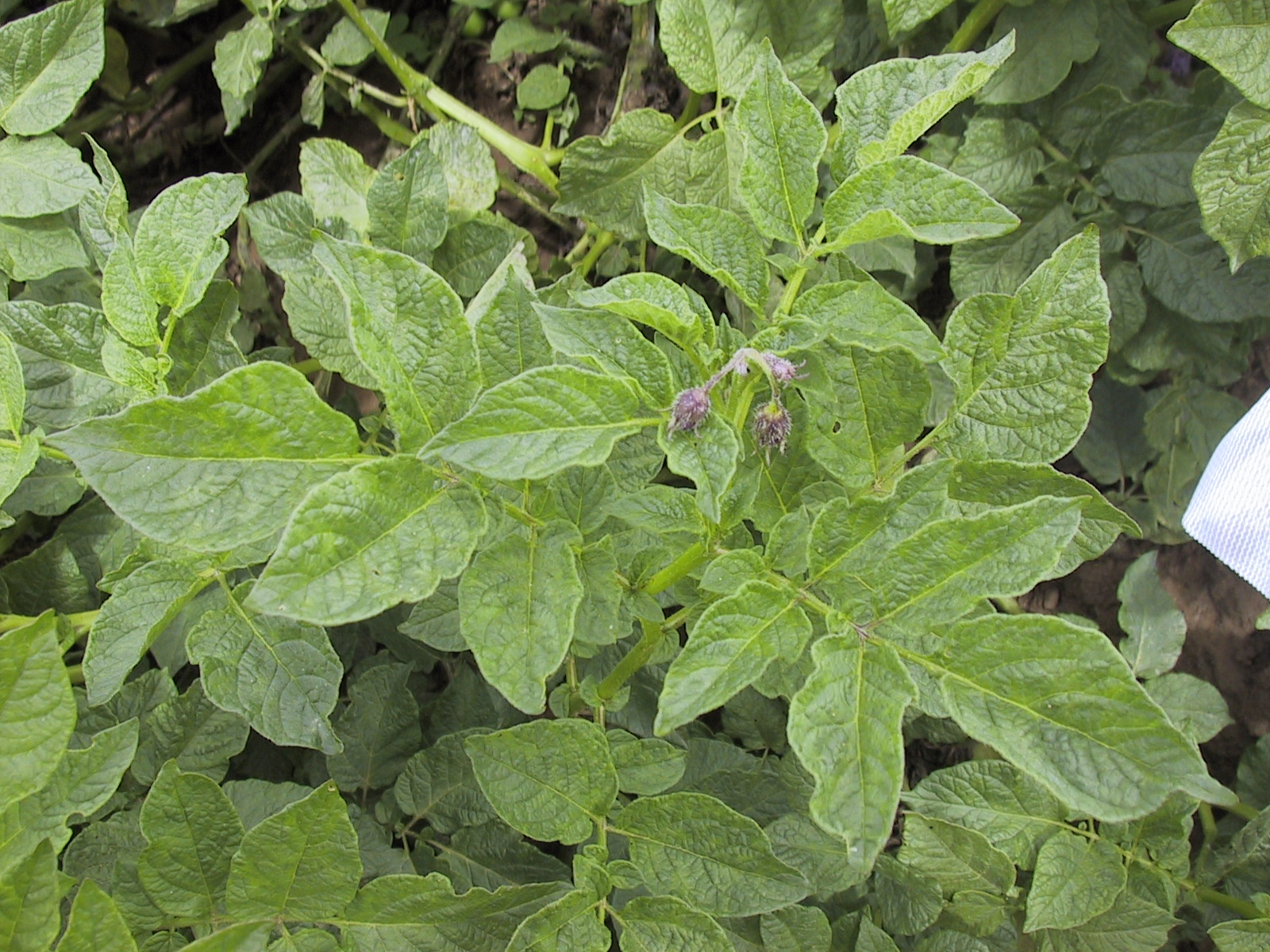 PVX (photo: CIP) |
Hosts
Bell pepper (Capsicum annuum), chili (Capsicum frutescens), tomato (Lycopersicon esculentum), tobacco (Nicotiana tabacum), potato (Solanum tuberosum), turnip (Brassica rapa subsp. rapa), globe artichoke (Cynara cardunculus L. var. scolymus), purple clover (Trifolium pratense), grapevine (Vitis vinifera), redroot pigweed (Amaranthus retrolexus), fat hen, lamb’s quarters (Chenopodium album), kangaroo apple (Solanum laciniatum)
Geographic distribution
Asia, Europe, Africa, North America, South America, Oceania
Biology and transmission
PVX is transmitted by contact from infected to healthy plant and also by farm machinery, clothes and animal skin presumably because it is very stable in vitro and highly infectious (Fribourg, 2007). It is also transmitted from infected to healthy sprouted tubers stored in the same bag (Bawden et al., 1948). Transmissions by zoospores of the fungus Synchytrium endobioticum (Nienhaus and Stille, 1965) have been reported. This is an interesting report as soil-borne transmission of PVX has been recorded (Salazar, 1996). Biting insects could occasionally transmit PVX by contact (Beemster, 1987).
Detection/indexing method in place at CIP
- Serotypes PVXo and PVXa , pathotypes 1 and HB (Fernandez-Northcote, 1990) and Strain-groups 1, 2, 3 and 4 (Cockerham 1955, 1970) have been reported in this virus.
- At CIP, the virus is detected by DAS-ELISA and host range.
Treatment/control
- In seed certification schemes, no virus infections must be tolerated during the growing season. Stocks of in vitro cultures used for propagation should be from pathogen-free plants and maintained under conditions designed to prevent infection and contamination.
Procedure followed at the centers in case of positive test
- In CIP if pathogen is detected the imported germplasm must be cleaned by thermotherapy.
References of protocols at EPPO, NAPPO or other similar organization
NAPPO. 2003. Regional standard for Phytosanitary Measures (RSPM) No.3. Requirements for importation of potatoes into a NAPPO member country. 53 pp.
OEPP/EPPO. 1998. EPPO certification scheme for seed potatoes. Bulletin OEPP/EPPO Bulletin 28:561-567.
References and further reading
Bawden FC, Kassanis B, Roberts FM.1948. Studies on the importance and control of potato virus X. Annals of Applied Biology, 35:250–265.
Beemster ABR, De Bokx JA. 1987. Survey of properties and symptoms. In: De Bokx JA, Van der Want JPH, eds. Viruses of potato and seed potato production. Wageningen, The Netherlands: Centre for Agricultural Publishing and Documentation, 84–113.
Cockerham G. 1955. Strains of potato virus X. Pp. 89-92 In: Proc. 2nd. Conf. Potato Virus diseases, Lisse-Wageningen, 1954.
Cockerham G. 1970. Genetical studies on resistance to potato viruses X and Y. Heredity 25:309-348.
Fernandez-Notrthcote EN. 1990. Variability of PVX and PVY and its relationship to genetic resistance. Pp. 131-139 In: International Potato Center (CIP). Control of Virus and Virus-like diseases of Potato and Sweet potato. Report of 3erd. Planning Conference, 20–22 Nov. 1989, Lima, Peru.
Fribourg C. 2007. Virus, viroides y mollicutes de las plantas cultivadas en el Perú. Universidad Nacional Agraria La Molina. Lima, Perú. 219 p.
Jeffries C. 1998. FAO/IPGRI Technical guidelines for the safe movement of Germplasm. No. 19. Potato. Food and Agriculture Organization of the United Nations, Rome/International Plant Genetic Resources Institute, Rome.
Nienhaus F, Stille B.1965. Ubertragung des Kartoffel-X-Virus durch Zoosporen von Synchytrium endobioticum. Phytopathologische Zeitschrift, 54:335–337.
Salazar LF. 1996. Potato Viruses and their Control. Lima, Peru: International Potato Center, 214 pp.
Seed Health General Publication Published by the Center or CGIAR
Jeffries C. 1998. FAO/IPGRI Technical guidelines for the safe movement of Germplasm. No. 19. Potato. Food and Agriculture Organization of the United Nations, Rome/International Plant Genetic Resources Institute, Rome.
Scientific name
Potato Virus S (PVS)
Two strain groups have been recognized, designated PVSo (ordinary) is distributed worldwide and PVSa (Andean) reported from Andean region of South America (Corzo, 1989; Hinostroza-Orihuela, 1973), and other parts of the world (Santillan, 1979; Cupertino y Oliveira, 1970; Slack, 1983; Rose, 1983).
Other scientific names
Potato S carlavirus
Pepino latent virus
Significance
Yield reduction ranges from 3 to 44% (Gladysiak and Wieckowski, 1977; Wright et al., 1977, Gandarillas, 1986; Corzo, 1989).
Symptoms
Symptoms are dependent mainly on incidence, virus strain, potato cultivar and environmental conditions. Generally, PVS is symptomless in many potato cultivars, however, some isolates cause undulation of leaf margins and some rugosity of leaf surfaces in susceptible potato cultivars and cause leaf bronzing, especially in very sensitive cultivars infected with virulent isolates (Beemster and de Bokx, 1987).
Hosts
Naturally restricted to potato and Pepino (Solanum muricatum).
Experimentally infects species of Chenopodiaceae and Solanaceae.
Geographic distribution
Asia, Europe, Africa, North America, South America, Oceania
Biology and transmission
PVS is readily transmitted mechanically (e.g., machinery) including plant-to-plant contact. Certain strains spread in a non-persistent manner by aphids, particularly Myzus persicae and Aphis nasturtti (Jeffries, 1998; Hooker, 1981). PVS has not been reported in true seed but transmission can occur readily in potato tubers and other vegetative parts including seedlings and micropropagated plants. Growing medium accompanying plants doesn’t carry virus propagules (CABI, 2007).
Detection/indexing method in place at CIP
- At CIP, the virus is detected by DAS-ELISA and host range.
Treatment/control
- In seed certification schemes, no virus infections must be tolerated during the growing season. Stocks of in vitro cultures used for propagation should be from pathogen-free plants and maintained under conditions designed to prevent infection and contamination.
Procedure followed at CIP in case of positive test
- In CIP if pathogen is detected the imported germplasm must be cleaned by thermotherapy.
References of protocols at EPPO, NAPPO or other similar organization
NAPPO. 2003. Regional standard for Phytosanitary Measures (RSPM) No.3. Requirements for importation of potatoes into a NAPPO member country. 53 pp.
OEPP/EPPO. 1998. EPPO certification scheme for seed potatoes. Bulletin OEPP/EPPO Bulletin 28:561–567.
References and further reading
Beemster ABR, de Bokx JA.1987. Survey of properties and symptoms. In: de Bokx, J.A. and van der Want, J.P.H. (Eds.) Viruses of Potato and Seed Potato Production. Wageningen, Netherlands: PUDOC, 84–113.
CABI. 2007. Crop Protection Compendium [online] Available from URL: www.cabi.org/compendia/cpc/ Commonwealth Agricultural Bureau International (CABI), Wallingford, UK. Date accessed 07 May 2010
Corzo P, Sánchez de Luque C, Malamud O, Salazar LF. 1989. Incidencia de virus en campos de producción de papa para consumo y para semilla. Fitopatología 24 (1):7–12
Cupertino FP, Oliveira AR. 1970. Presença do virus S em batata-semente nacional e estrangeira. Bragantia 29:17–20
Gandarillas A. 1986. Diseminación de algunos virus de papa en las zonas de Huancayo e Ica. Tesis M. Sci. Fitopatología. Universidad Nacional Agraria La Molina, Lima, Peru.
Gladysiak S, Wieckowski A.1977. Effect of secondary virus S infection on yield of two varieties of potato. Rocz. AR Pozn. No.97:89–94.
Hinostroza-Orihuela AM. 1973. Some properties of potato virus S isolated from Peruvian potatoes. Potato Research 16:244–250
Hooker WJ. (ed.). 1981. Compendium of Potato Diseases. American Phytopathological Society. St. Paul, Minnesota, USA. 125 pp.
Howell PJ. 1981. The risks from exotic potato viruses. EPPO Bulletin, 11(3):243–249.
Rose DG. 1983. Some properties of an unusual isolate of potato virus S. Potato Research 26:49–62.
Santillán F, Fribourg CE, Jones RAC. 1980. Estudio comparativo de 11 aislamientos de virus S de la papa (PVS) de la región andina. Fitopatología 15 (1):42–43.
Slack SA. 1983. Identification of an isolate of the Andean strain of potato virus S in North America. Plant. Dis. 67:786–789
Wright NS, Mellor FC, Cole EF, Hyams CM.1977. Control of PVX and PVS in seed potatoes. Canada Agriculture, 22(2):14–16;
Seed Health General Publication Published by the Center or CGIAR
Jeffries C. 1998. FAO/IPGRI Technical guidelines for the safe movement of Germplasm. No. 19. Potato. Food and Agriculture Organization of the United Nations, Rome/International Plant Genetic Resources Institute, Rome.
Scientific name
Potato Virus M (PMV)
Significance
Often symptomless. Causes mottle, mosaic, crinkling and rolling of leaves (paracrinkle), and stunting of shoots. Symptoms mainly occur in plants infected at very young stage. Severity is influenced by virus isolate and potato cultivar.
Symptoms
Most strains of the virus induce no conspicuous symptoms in many potato cultivars (for example, Green Mountain, Irish Cobbler, Sebago and Up-to-Date). However, in some cultivars (for example, Climax, Fortuna, Hatahdin, King Edward and White Rose) some strains induce very mild leaf chlorosis and leaf distortion, and in a few (for example, cultivars Arran Victory) they can cause severe leaf mottling, chlorosis, crinkling and rolling and stunting. The severity of symptoms is dependent on the virulence of the infecting virus strain, the tolerance of the cultivar and, possibly, environmental factors (Beemster and Rozendaal, 1972).
Hosts
Potato is the major natural host of PVM.
Experimentally can be transmitted to another 122 species in 9 genera of the Solanaceae and to 47 species in the Amaranthaceae, Caryophyllaceae, Chenopodiaceae, Compositae, Cucurbitaceae, Fabaceae and Rubiaceae (Bagnall et al., 1956, 1959; Hiruki, 1970; de Bokx and Chrzanska, 1972; Kowalska and Was, 1976; Edwardson and Christie, 1997).
Geographic distribution
Asia, Europe, Africa, North America, South America.
Biology and transmission
The virus is transmitted in the non-persistent manner by aphids (MacKinnon, 1974). Some isolates, however may be transmitted mechanically (e.g., machinery) including plant-to-plant contact (Jeffries, 1998). The widespread geographical occurrence of the virus is probably attributable to the inadvertent international distribution of infected tubers. PVM has not been reported in true seed but transmission can occur readily in potato tubers and other vegetative parts including seedlings and micropropagated plants. Growing medium accompanying plants doesn’t carry virus propagules (CABI, 2007).
Detection/indexing method in place at CIP
- At CIP, virus is detected by DAS-ELISA
Treatment/control
- In seed certification schemes, no virus infections must be tolerated during the growing season. Stocks of in vitro cultures used for propagation should be from pathogen-free plants and maintained under conditions designed to prevent infection and contamination.
Procedure followed at CIP in case of positive test
- In CIP if pathogen is detected the imported germplasm must be cleaned by thermotherapy.
References of protocols at EPPO, NAPPO or other similar organization
NAPPO. 2003. Regional standard for Phytosanitary Measures (RSPM) No.3. Requirements for importation of potatoes into a NAPPO member country. 53 pp.
OEPP/EPPO. 1998. EPPO certification scheme for seed potatoes. Bulletin OEPP/EPPO Bulletin 28:561–567.
References and further reading
Bagnall RH, Larson RH, Walker JC.1956. Potato viruses M, S and X in relation to interveinal mosaic of the Irish Cobbler variety. Bulletin of the Wisconsin Agricultural Research Station No. 198.
Beemster ABR, Rozandaal A. 1972. Potato viruses; properties and symptoms. In: Bokx ,J.A. de (Ed.). Viruses of Potatoes and Seed-Potato Production. Pudoc, Wageningen, The Netherlands: PUDOC, 115–143.
CABI. 2007. Crop Protection Compendium [online] Available from URL: www.cabi.org/compendia/cpc/ Commonwealth Agricultural Bureau International (CABI), Wallingford, UK. Date accessed 07 May 2010
Edwardson JR, Christie RG. 1997. Viruses infecting peppers and other solanaceous crops; Volume 1:106–123. Gainesville, Florida, USA: University of Florida.
Hiruki C. 1970. Red kidney bean, a useful bioassay host for qualitative and quantitative work with potato virus M. Phytopathology, 60:739–740.
Jeffries C. 1998. FAO/IPGRI Technical guidelines for the safe movement of Germplasm. No. 19. Potato. Food and Agriculture Organization of the United Nations, Rome/International Plant Genetic Resources Institute, Rome.
Kowalska A, Was M.1976. Detection of potato virus M and potato virus S on test plants. Potato Research, 19(2):131–139
MacKinnon JP. 1974. Detection, spread and aphid transmission of potato virus S. Canadian Journal of Botany, 52:461–465.
Seed Health General Publication Published by the Center or CGIAR
Jeffries C. 1998. FAO/IPGRI Technical guidelines for the safe movement of Germplasm. No. 19. Potato. Food and Agriculture Organization of the United Nations, Rome/International Plant Genetic Resources Institute, Rome.
Scientific name
Potato Virus A (PVA)
Significance
Yield reduction can be up to 40% (Jeffries, 1998).
Symptoms
PVA causes mild mosaic. Mottles may appear on the veins, and infected leaves look shiny (Wale, 2008). Severe disease in combination with the potato virus x and / or PVY. Severity of symptom expression depends on whether conditions, potato cultivars and the strain of virus A (Hooker,1981)
Hosts
Mainly potato (Solanum tuberosum), peppers (Capsicum spp.) and tobacco (Nicotiana tabacum) (CABI, 2007)
Geographic distribution
Asia, Europe, Africa, North America, South America, Oceania
Biology and transmission
By aphids (Aphis frangulae, Macrosiphum euphorbiae and myzus persicae) in a non-persistent manner (Wale, 2008).
Detection/indexing method in place at CIP
- At CIP, virus is detected by DAS-ELISA
Treatment/control
- In seed certification schemes, no virus infections must be tolerated during the growing season. Stocks of in vitro cultures used for propagation should be from pathogen-free plants and maintained under conditions designed to prevent infection and contamination.
Procedure followed at CIP in case of positive test
- In CIP if pathogen is detected the imported germplasm must be cleaned by thermotherapy.
References of protocols at EPPO, NAPPO or other similar organization
NAPPO. 2003. Regional standard for Phytosanitary Measures (RSPM) No.3. Requirements for importation of potatoes into a NAPPO member country. 53 pp.
OEPP/EPPO. 1998. EPPO certification scheme for seed potatoes. Bulletin OEPP/EPPO Bulletin 28:561–567.
References and further reading
CABI. 2007. Crop Protection Compendium [online] Available from URL: www.cabi.org/compendia/cpc/ Commonwealth Agricultural Bureau International (CABI), Wallingford, UK. Date accessed 07 May 2010
Hooker WJ. (ed.). 1981. Compendium of Potato Diseases. American Phytopathological Society. St. Paul, Minnesota, USA. 125 pp.
Jeffries C. 1998. FAO/IPGRI Technical Guidelines for the Safe Movement of Germplasm. No. 19. Potato. Food and Agriculture Organization of the United Nations, Rome/International Plant Genetic Resources Institute, Rome.
Wale S, Platt HW (Bud), Cattlin N. 2008. Diseases, pests and disorders of Potatoes. A color Handbook. Manson Publishing, London, UK.176 pp.
Seed Health General Publication Published by the Center or CGIAR
Jeffries C. 1998. FAO/IPGRI Technical guidelines for the safe movement of Germplasm. No. 19. Potato. Food and Agriculture Organization of the United Nations, Rome/International Plant Genetic Resources Institute, Rome.
Scientific name
Potato Leaf Roll Virus (PLRV)
Significance
PLRV is not considered a pathogen of quarantine status because of its wide distribution.
PLRV causes severe yield loss (up to 90%) and, in some cultivars quality reduction due to internal damage to tubers (net necrosis) (Jeffries, 1998). One estimate has suggested the virus is responsible for yield losses of 20 million tons globally (Wale, 2008).
Symptoms
Foliage: Primary symptoms develop in plants infected with the virus during the current season and are usually are restricted to pal discoloration or anthocianescence of the tops of the plants and slight leafrolling of the leaflets (Jeffries, 1998, Hooker, 1991). Some purple discoloration of affected leaflets may occur. (Wale, 2008) Symptoms may be absent, particularly if infection occurs late in the season.
Secondary symptoms develop in plants arising from infected tubers. Inward rolling of lower leaflets, extending ultimately to upper leaves, is typical. Rolled leaves are leathery and break easily when crushed between the fingers due to the excessive accumulation of carbohydrates. PLRV infected plants are usually stunted and erect and produce normal-shaped, but small, tubers (Wale, 2008). In some cultivars, severe chlorosis may develop in apical leaves. Conspicuous variations in symptoms can be observed in some genotypes (Jeffries, 1998).
Tubers: Some varieties may develop internal necrosis (net necrosis) in the tubers as a result of primary, secondary or tertiary infection with PLRV (Douglas and Pavek, 1972). Net necrosis may not be apparent at harvest but can develop in store (Wale, 2008).
Hosts
Solanum tuberosum , Ullucus tuberosus (Lizarraga, 1996), Capsella bursa-pastoris (Fox, 1993), Capsicum annuum and Lycopersicon esculentum has been reported as natural hosts.
About 20 species largely in the Solanaceae and a few non-solanaceous host including C. bursa-pastoris, Gomphrena and Montia perfoliata have been artificially infected (Jeffries, 1998).
Geographic distribution
Asia, Europe, North America, Central America, South America, Oceania
Biology and transmission
PLRV is transmitted by several aphid species in a persistent (circulative manner) principally by Myzus persicae. The virus can be spread long-distances by winged aphids, however, virus distribution occurs mainly through infected potato seed tubers and other vegetative parts including seedlings and micropropagated plants. PLRV has not been reported in true seed (CABI, 2007).
Detection/indexing method in place at CIP
- At CIP, the virus is detected by DAS-ELISA.
Treatment/control
- In seed certification schemes, no virus infections must be tolerated during the growing season. Stocks of in vitro cultures used for propagation should be from pathogen-free plants and maintained under conditions designed to prevent infection and contamination.
Procedure followed at CIP in case of positive test
- In CIP if pathogen is detected the imported germplasm must be cleaned by thermotherapy.
References of protocols at EPPO, NAPPO or other similar organization
NAPPO. 2003. Regional standard for Phytosanitary Measures (RSPM) No.3. Requirements for importation of potatoes into a NAPPO member country. 53 pp.
OEPP/EPPO. 1998. EPPO certification scheme for seed potatoes. Bulletin OEPP/EPPO Bulletin 28:561–567.
References and further reading
CABI. 2007. Crop Protection Compendium [online] Available from URL: www.cabi.org/compendia/cpc/ Commonwealth Agricultural Bureau International (CABI), Wallingford, UK. Date accessed 07 May 2010
Douglas DR, Pavek JJ. 1972. Net necrosis of potato tubers associated with primary, secondary and tertiary infection of leafroll. American Potato Journal, 49:330–333.
Fox L, Biever KD, Toba HH, Duffus JE, Thomas PE. 1993. Overwintering and monitoring of potato leafroll virus in some wild crucifers. American Potato Journal, 70(7):505-515.
Hooker WJ. (ed.). 1981. Compendium of potato diseases. American Phytopathological Society. St. Paul, Minnesota, USA. 125 pp.
Jeffries C. 1998. FAO/IPGRI Technical Guidelines for the Safe Movement of Germplasm. No. 19. Potato. Food and Agriculture Organization of the United Nations, Rome/International Plant Genetic Resources Institute, Rome.
Lizárraga C, Santa Cruz M, Salazar LF.1996. First report of potato leafroll luteovirus in ulluco (Ullucus tuberosus Caldas). Plant Disease, 80(3):344.
Wale S, Platt, HW (Bud), Cattlin N. 2008. Diseases, pests and disorders of Potatoes. A Color Handbook. Manson Publishing, London, UK.176 pp.
Seed Health General Publication Published by the Center or CGIAR
Jeffries C. 1998. FAO/IPGRI Technical Guidelines for the Safe Movement of Germplasm. No. 19. Potato. Food and Agriculture Organization of the United Nations, Rome/International Plant Genetic Resources Institute, Rome.
Comments
- No comments found
Leave your comments
Post comment as a guest