


Viruses - maize

Contributors to this section: CIMMYT, Mexico (Etienne Duveiller, Monica Mezzalama, Eloise Phipps), Independent consultant (Jesse Dubin).
|
Contents: |
Pathogen name
Maize dwarf mosaic virus (MDMV)
Importance
High economic importance, moderate phytosanitary importance.
Significance
Maize yield can be severely affected by MDMV. Yield losses of maize in the field can be as high as 40%. Moreover, in maize inbred lines or sweetcorn, especially after later sowing, yield can be reduced by 75% or more. Several crop loss studies in the USA, particularly with artificial inoculation, have reported yield reductions of 70 to 90%. In combination with maize chlorotic mottle virus, MDMV may also cause a severe reaction known as maize lethal necrosis.
Symptoms
Symptoms vary widely depending on host genotype and time of infection. Generally, infected plants develop a distinct mosaic—irregularities in the distribution of normal green color—typically appearing at the bases of the youngest leaves. There may also be narrow chlorotic streaks extending parallel to the veins. Later, the youngest leaves show a general chlorosis, and streaks are larger and more abundant. Reddish-violet discoloration and necrosis may also occur, particularly in sweetcorn and maize inbred lines. Any leaves that are already mature at the time of infection are not affected.
Infected plants are characterized by stunting (of variable severity) and shortening of upper internodes. Sterility is a common symptom of MDMV, often reaching 25% or more. In maize inbred lines, especially after an early infection, sterility can be much higher, causing complete or very high yield loss. Ear development can also be arrested, leading to incomplete grain filling. Plants infected early may produce nubbins or be totally barren. In severe cases the virus can cause premature plant death.
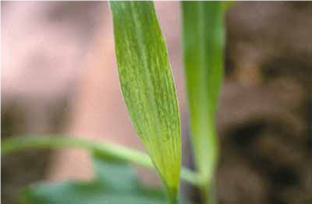 Maize dwarf mosaic (photo: CIMMYT) |
Hosts
Major hosts: maize, Johnson grass (Sorghum halepense).
Minor hosts: oats (Avena sativa), millet (Panicum miliaceum), sugarcane (Saccharum officinarum).
Wild hosts: prairiegrass (Bromus catharticus), purpletop chloris (Chloris barbata), sour paspalum (Paspalum conjugatum), pearl millet (Pennisetum glaucum), Sudan grass (Sorghum sudanense), buffalo grass (Stenotaphrum secundatum), eastern gamagrass (Tripsacum dactyloides), marmalade grass (Urochloa plantaginea).
Geographic distribution
Worldwide.
Biology and transmission
Numerous aphid species (both adults and nymphs) transmit MDMV in a non-persistent manner. The virus is acquired by the aphid within ten seconds to two minutes of feeding and a latent period is not required. The virus overwinters in alternate hosts. The virus can be sap-transmitted under laboratory conditions. It is also transmitted by seed at low rates.
Detection/indexing methods used at CIMMYT
- Germination test on sterile soil.
- Detection with ELISA using AGDIA protocol (http://www.agdia.com).
Treatment/control
- Resistance, cultural practices, insecticides
Procedures followed in case of positive test used at CIMMYT
The seed lot is destroyed.
References and further reading
CAB International. 2007. Datasheet: Maize dwarf mosaic virus. In Crop Protection Compendium, 2007 Edition. Published as CD-ROM and website. Wallingford, UK: CAB International.
CIMMYT. Maize Doctor information sheet: Maize dwarf mosaic virus. [online] Available from URL: http://maizedoctor.cimmyt.org/index.php?option=com_content&task=view&id=209. Extended information sheet: Maize dwarf mosaic virus. [online] Available from URL: http://maizedoctor.cimmyt.org/index.php?option=com_content&task=view&id=238. Date accessed 10 April 2010
McGee DC. 1988. Maize Diseases: A Reference Source for Seed Technologists. St. Paul, MN: APS Press. pp. 38-40.
The CIMMYT Maize Program. 2004. Maize Diseases: A Guide for Field Identification. 4th Edition. Mexico, D.F.: CIMMYT. pp. 94-95.
Pathogen name
Sugarcane mosaic virus (SCMV)
Importance
Moderate economic importance, low phytosanitary importance.
Significance
Yield losses due can be extensive, and in China the virus has been reported to seriously affect maize production. In Germany, SCMV was found to be more prevalent than MDMV, and to have a similar effect on growth and yield of maize. Early infection reduced plant height by 25%, total weight by 38%, and ear weight by 27%. In East Africa, inoculation with SCMV at the seedling stage caused yield losses of 18-46% in ten susceptible maize hybrids. Inoculation with the virus in Australia caused similar losses of up to 50%.
Symptoms
Symptoms vary widely depending on host genotype and time of infection. Generally, infected plants develop a distinct mosaic—irregularities in the distribution of normal green color—typically appearing at the bases of the youngest leaves. There may also be narrow chlorotic streaks extending parallel to the veins. Later, the youngest leaves show a general chlorosis, and streaks are larger and more abundant. Reddish-violet discoloration and necrosis may also occur, particularly in sweetcorn and maize inbred lines. Any leaves that are already mature at the time of infection are not affected.
Infected plants are characterized by stunting (of variable severity) and shortening of upper internodes. Sterility is a common symptom of MDMV, often reaching 25% or more. In maize inbred lines, especially after an early infection, sterility can be much higher, causing complete or very high yield loss. Ear development can also be arrested, leading to incomplete grain filling. Plants infected early may produce nubbins or be totally barren. In severe cases the virus can cause premature plant death.
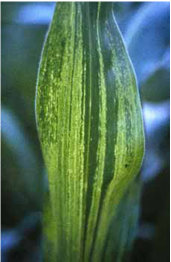 Sugarcane mosaic of maize (photo: CIMMYT) |
Hosts
Major hosts: maize, sugarcane (Saccharum officinarum), Johnson grass (Sorghum halepense).
Wild hosts: numerous grasses (Poaceae).
Geographic distribution
Worldwide.
Biology and transmission
Numerous aphid species (both adults and nymphs) transmit SCMV in a non persistent manner, with no latent period required. The virus overwinters in alternate hosts. It is also transmitted by seed at low rates.
Detection/indexing methods used at CIMMYT
- Germination test on sterile soil
- Detection with ELISA using AGDIA protocol (http://www.agdia.com).
Treatment/control
- Insecticides for aphid control
Procedures followed in case of positive test used at CIMMYT
- The seed lot is destroyed.
References and further reading
CAB International. 2007. Datasheet: Sugarcane mosaic virus. In Crop Protection Compendium, 2007 Edition. Published as CD-ROM and website. Wallingford, UK: CAB International.
CIMMYT. Maize Doctor information sheet: MDMV/SCMV. [online] Available from URL: http://maizedoctor.cimmyt.org/index.php?option=com_content&task=view&id=209. Extended information sheet: MDMV/SCMV. [online] Available from URL: http://maizedoctor.cimmyt.org/index.php?option=com_content&task=view&id=238. Date accessed 10 April 2010
McGee DC. 1988. Maize Diseases: A Reference Source for Seed Technologists. St. Paul, MN: APS Press. pp. 38-40.
The CIMMYT Maize Program. 2004. Maize Diseases: A Guide for Field Identification. 4th Edition. Mexico, D.F.: CIMMYT. pp. 94-95.
Pathogen name
Maize chlorotic mottle virus (MCMV)
Importance
High economic importance, low phytosanitary importance.
Significance
The disease was first reported in Peru in 1973, where it can causes losses of 10-15% in some cultivars. Inoculation reduced yields by 50%. The combination of MCMV with maize dwarf mosaic virus or wheat streak mosaic virus may also cause a severe reaction known as maize lethal necrosis (MLN).
Symptoms
Fine chlorotic spots, appearing first on the youngest leaves, which coalesce and develop into broad chlorotic stripes along the veins. These chlorotic stripes contrast with dark green tissue when observed against the light. Affected leaves later die. Infected plants are stunted because of shortened internodes, and produce fewer and smaller ears. In most cases the tassel is malformed.
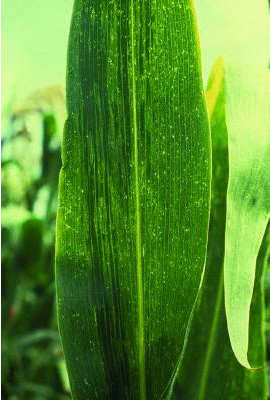 Maize chlorotic mottle virus (MCMV)(photo: CIMMYT) |
Hosts
Maize, teosinte.
Geographic distribution
USA, Mexico, Argentina, Brazil, Peru.
Biology and transmission
The virus is transmitted mainly by several species of chysromelid leaf beetle, such as the corn flea beetle (Chaetocmena pulicaria), the cereal leaf beetle (Oulema melanopa), and corn rootworms (Diabrotica spp). The virus overwinters on crop residues; beetle larvae that feed on the residues in the absence of fresh material later transmit the virus to the new crop. Reports indicate that it is also transmitted at very low rates via infected seed.
Detection/indexing methods used at CIMMYT
- Germination test on sterile soil.
- Detection with ELISA using AGDIA protocol (http://www.agdia.com).
Treatment/control
- Insect control and cultural practices
Procedures followed in case of positive test used at CIMMYT
- The seed lot is destroyed.
References and further reading
CAB International. 2007. Datasheet: Maize chlorotic mottle virus. In Crop Protection Compendium, 2007 Edition. Published as CD-ROM and website. Wallingford, UK: CAB International.
McGee DC. 1988. Maize Diseases: A Reference Source for Seed Technologists. St. Paul, MN: APS Press. pp. 124-125.
The CIMMYT Maize Program. 2004. Maize Diseases: A Guide for Field Identification. 4th Edition. Mexico, D.F.: CIMMYT. pp. 92-93.
Comments
- No comments found
Leave your comments
Post comment as a guest